Reading shared configuration at build time
Why every app in the ecosystem fetches one registry before it builds, and why a failed fetch should fail the build instead of falling back.

On this page
Every project in the ecosystem needs a few shared facts: where Support lives, what the Gateway URL is, which projects are public. Hardcoding them in each repository works until the first rename. After that, every copy drifts on its own schedule.
One registry, many readers
The registry is a plain JSON file generated from small source files and validated against JSON Schemas. Apps don't install it as a package; they fetch the published file before dev, build, typecheck and test, and keep only the fields they use.
- The sync step validates what it reads, not the whole registry, and ignores fields it doesn't know.
- It writes a minimal projection to a git-ignored file, so the full registry never reaches a visitor's browser.
- It resolves deployment URLs the same way everywhere: an explicit
urlas written, otherwise the subdomain plus the primary domain.
No stale fallback
The tempting design is a checked-in snapshot that takes over when the fetch fails. It keeps the build green and quietly ships yesterday's facts. A failed sync here removes the generated file and fails the command, so a broken registry stops a deploy instead of reaching visitors.
const response = await fetch(CONFIG_URL, { cache: "no-store" });if (!response.ok) throw new Error(`Config fetch failed: HTTP ${response.status}`);const projection = projectEcosystem(await response.json());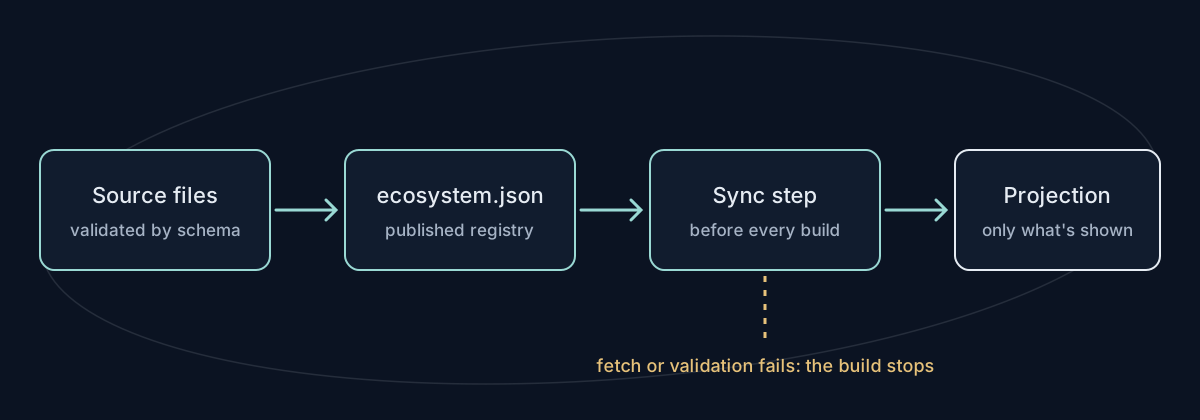
| Approach | When the fetch fails | What visitors see |
|---|---|---|
| Checked-in snapshot | The build passes | Possibly outdated facts |
| No fallback (this journal) | The build stops | The last working deployment |
curl -s https://raw.githubusercontent.com/Fikrimarzuki/ecosystem-config/main/dist/ecosystem.json | node -e 'let s="";process.stdin.on("data",c=>s+=c).on("end",()=>console.log(Object.keys(JSON.parse(s).projects).length))'What it costs
Builds need the network, and a registry outage blocks deploys. For a small ecosystem that is the right trade: the failure is loud, short and obvious, and the alternative fails silently.